
 Hyundai Veloster: Yaw-rate and Lateral G Sensor. Description and Operation
Hyundai Veloster 2011-2017 Service Manual / Brake System / ESC(Electronic Stability Control) System / Yaw-rate and Lateral G Sensor. Description and Operation
Hyundai Veloster: Yaw-rate and Lateral G Sensor. Description and Operation
Hyundai Veloster 2011-2017 Service Manual / Brake System / ESC(Electronic Stability Control) System / Yaw-rate and Lateral G Sensor. Description and Operation
Hyundai Veloster 2011-2017 Service Manual / Brake System / ESC(Electronic Stability Control) System / Yaw-rate and Lateral G Sensor. Description and Operation
Description
When the vehicle is turning with respect to a vertical axis the yaw rate
sensor detects the yaw rate electronically by the vibration change of plate
fork inside the yaw rate sensor.
If yaw velocity reaches the specific velocity after it detects the vehicle'yawing,
the ESC control is reactivated.
The later G sensor senses vehicle's lateral G. A small element inside
the sensor is attached to a deflectable leverarm by later G.
Direction and magnitude of lateral G loaded to vehicle can be known with
electrostatic capacity changing according to lateral G.
The longitudinal G sensor is installed in the yaw-rate sensor.
This longitudinal G sensor detects vertical acceleration of the vehicle,
while the lateral G sensor detects lateral acceleration of the vehicle. The
HECU uses these signals for the Hill start Assist Control function.
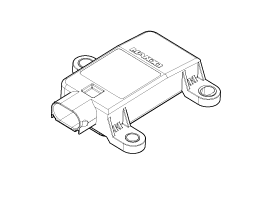
Specifications
|
Description |
Specification |
Remarks |
|
|
Operating voltage |
10 ~ 16V |
|
|
|
Output signal |
CAN Interface |
|
|
|
Operating temperature |
-40 ~ 85°C (-40 ~ 185°F) |
|
|
|
Yaw-rate sensor |
Measurement range |
-75 ~ 75°/sec |
|
|
Frequency response |
15 ~ 45Hz |
|
|
|
G sensor (Lateral / Longitudinal) |
Measurement range |
-14.715 ~ +14.715g |
|
|
Frequency response |
50Hz ± 60% |
|
|
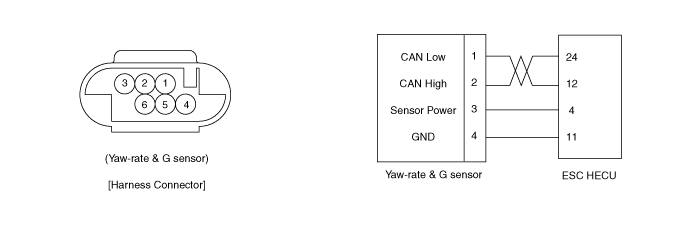
External Diagram
 Rear Wheel Speed Sensor. Repair procedures
Removal
1.
Remove the rear wheel and tire.
Tightening torque:
88.3 ~ 107.9 N.m (9.0 ~ 11.0 kgf.m, 65.1 ~ 79.6 lb-ft)
...
 Yaw-rate and Lateral G Sensor. Repair procedures
Removal
1.
Turn ignition switch OFF and disconnect the negative (-) battery
cable.
2.
Remove the passenger seat assembly.
(Refer ...
See also:
Description and Operation
Description
Emissions Control System consists of three major systems.
•
The Crankcase Emission Control System prevents blow-by gas from
releasing into the atmosphere. T ...
Rear Washer Switch. Repair procedures
Inspection
Check for continuity between the terminals while operating the wiper and
washer switch. If it is not normal condition, replace wiper and washer switch.
Rear Wiper Switch
...
Dual Clutch System. Description and Operation
Description
The dual clutch is installed within the transmission.
The dual clutch comprises an odd clutch and an even clutch. The odd clutch
transfers and cuts off engine power to the tran ...
Categories
- Hyundai Veloster Manuals Home
- Hyundai Veloster 2010-2017 Owner's Manual
- Hyundai Veloster 2010-2017 Service Manual

© 2011-2026 Copyright www.hvmanual.com