
 Hyundai Veloster: Description and Operation
Operation and Leakage Check
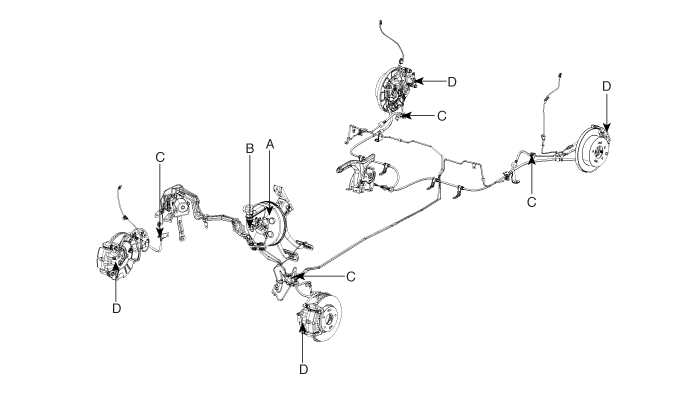
| Check all of the following items: |
|
Component |
Procedure |
||||
|
Brake Booster (A) |
Check brake operation by applying the brakes during a test drive.
If the brakes do not work properly, check the brake booster. Replace the
brake booster as an assembly if it does not work properly or if there are
signs of leakage. |
||||
|
Piston cup and pressure cup inspection (B) |
|
||||
|
Brake hoses (C) |
Look for damage or signs of fluid leakage. Replace the brake hose
with a new one if it is damaged or leaking. |
||||
|
Caliper piston seal and piston boots (D) |
Check brake operation by applying the brakes. Look for damage or signs of fluid leakage. If the pedal does not work properly, the brakes drag, or there is damage or signs of fluid leakage, disassemble and inspect the brake caliper. Replace the boots and seals with new ones whenever the brake caliper is disassembled. |
| Brake System Bleeding |
|

| 1. |
Make sure the brake fluid in the reservoir is at the MAX(upper)
level line.
|
| 2. |
Have someone slowly pump the brake pedal several times, and then
apply pressure.
|
| 3. |
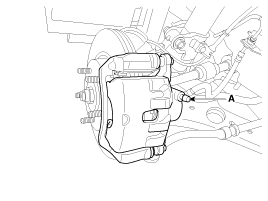
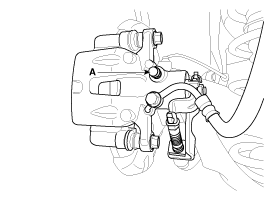
Loosen the right-rear brake bleed screw (A) to allow air to escape
from the system. Then tighten the bleed screw securely.
[Front disc brake]
[Rear disc brake]
|
| 4. |
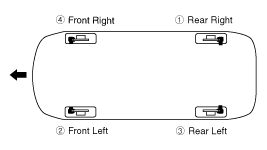
Repeat the procedure for wheel in the sequence shown below until
air bubbles no longer appear in the fluid.
|
| 5. |
Refill the master cylinder reservoir to MAX(upper) level line.
|
 Brake System
...
 Brake Booster. Components and Components Location
Components (1)
1. Brake booster
2. Master cylinder assembly
3. O-ring
Components (2)
1. Vacuum pump
2. Bracket
...
See also:
Driving in flooded areas
Avoid driving through flooded areas unless you are sure the water is no higher
than the bottom of the wheel hub. Drive through any water slowly. Allow adequate
stopping distance because brake perf ...
Illuminated ignition switch
Whenever a front door is opened, the ignition switch will be illuminated for
your convenience, provided the ignition switch is not in the ON position. The light
will go off immediately when the ...
Steering Gear box. Repair procedures
Replacement
1.
Remove the front wheel & tire.
Tightening torque :
88.3 ~ 107.9N.m(9.0 ~ 11.0kgf.m, 65.1 ~ 79.6lb-ft)
...
Categories
- Hyundai Veloster Manuals Home
- Hyundai Veloster 2010-2017 Owner's Manual
- Hyundai Veloster 2010-2017 Service Manual

© 2011-2026 Copyright www.hvmanual.com