
 Hyundai Veloster: Rear Glass Defogger Printed Heater. Repair procedures
Hyundai Veloster 2011-2017 Service Manual / Body Electrical System / Rear Glass Defogger / Rear Glass Defogger Printed Heater. Repair procedures
Hyundai Veloster: Rear Glass Defogger Printed Heater. Repair procedures
Hyundai Veloster 2011-2017 Service Manual / Body Electrical System / Rear Glass Defogger / Rear Glass Defogger Printed Heater. Repair procedures
Hyundai Veloster 2011-2017 Service Manual / Body Electrical System / Rear Glass Defogger / Rear Glass Defogger Printed Heater. Repair procedures
Inspection
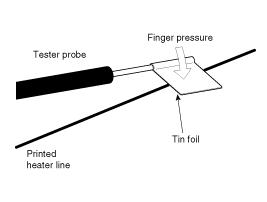
Wrap tin foil around the end of the voltmeter test lead to prevent
damaging the heater line. Apply finger pressure on the tin foil, moving
the tin foil along the grid line to check for open circuits.
|

| 1. |
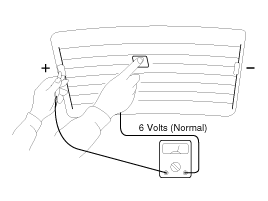
Turn on the defogger switch and use a voltmeter to measure the
voltage of each heater line at the glass center point. If a voltage
of approximately 6V is indicated by the voltmeter, the heater line of
the rear window is considered satisfactory.
|
| 2. |
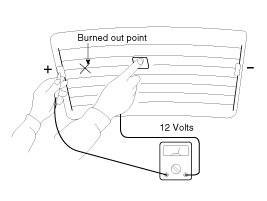
If a heater line is burned out between the center point and (+)
terminal, the voltmeter will indicate 12V.
|
| 3. |
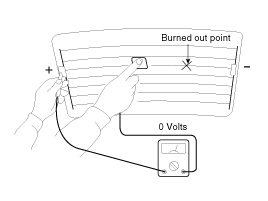
If a heater line is burned out between the center point and (-)
terminal, the voltmeter will indicate 0V.
|
| 4. |
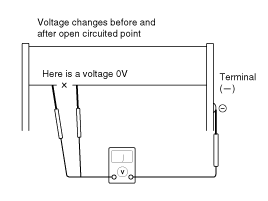
To check for open circuits, slowly move the test lead in the direction
that the open circuit seems to exist. Try to find a point where a voltage
is generated or changes to 0V. The point where the voltage has changed
is the open-circuit point.
|
| 5. |
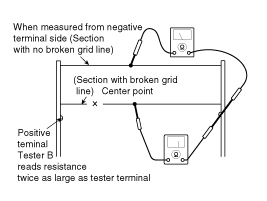
Use an ohmmeter to measure the resistance of each heater line
between a terminal and the center of a grid line, and between the same
terminal and the center of one adjacent heater line. The section with
a broken heater line will have a resistance twice as that in other sections.
In the affected section, move the test lead to a position where the
resistance sharply changes.
|
| 6. |
If the heat line fails, replace the rear glass.
(Refer to the BD group - "Interior - Tailgate glass")
|
 Components and Components Location
Component Location
1. Rear glass defogger relay (Engine room relay box)
2. Rear glass defogger switch (A/C controller)
3. Rear glass defogger
...
 Rear Glass Defogger Switch. Repair procedures
Inspection
1.
The rear glass defogger switch inputs can be checked using the
GDS.
2.
To check the input value of rear glass defogger switc ...
See also:
General Information
General
The supplemental restraint system (SRS) is designed to supplement the
seat belt to help reduce the risk or severity of injury to the driver and passenger
by activating and deploying ...
Changing the engine oil and filter
Have engine oil and filter changed by an authorized HYUNDAI dealer according
to the Maintenance Schedule at the beginning of this section.
CALIFORNIA PROPOSITION 65 WARNING
Engine oil contains c ...
Scheduled maintenance service
Follow Normal Maintenance Schedule if the vehicle is usually operated where none
of the following conditions apply. If any of the following conditions apply, follow
Maintenance Under Severe Usage ...
Categories
- Hyundai Veloster Manuals Home
- Hyundai Veloster 2010-2017 Owner's Manual
- Hyundai Veloster 2010-2017 Service Manual

В© 2011-2026 Copyright www.hvmanual.com