
 Hyundai Veloster: Manual transaxle operation
Hyundai Veloster 2011-2017 Owner's Manual / Driving your vehicle / Manual transaxle / Manual transaxle operation
Hyundai Veloster: Manual transaxle operation
Hyundai Veloster 2011-2017 Owner's Manual / Driving your vehicle / Manual transaxle / Manual transaxle operation
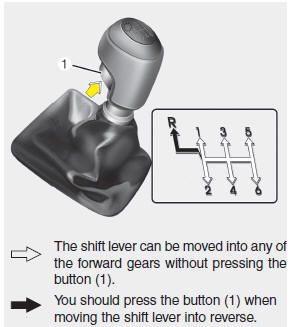
The manual transaxle has 6 forward gears.
This shift pattern is imprinted on the shift knob. The transaxle is fully synchronized in all forward gears so shifting to either a higher or a lower gear is easily accomplished.
To shift gears, press the clutch pedal down fully, select the desired gear with the gearshift lever, and release the clutch pedal slowly.
If your vehicle is equipped with an ignition lock switch, the engine will not start when starting the engine without depressing the clutch pedal.
The shift lever must be returned to the neutral position before shifting into R (Reverse). The button (1) located at the bottom front of the shift knob must be pressed and held in while moving the shift lever to the R (Reverse) position.
Make sure the vehicle is completely stopped before shifting into R (Reverse). Never operate the engine with the tachometer (rpm) in the red zone.
CAUTION
- • When downshifting from fifth gear to fourth gear, caution should be taken not to inadvertently press the shift lever sideways in such a manner that the second gear is engaged. Such a drastic downshift may cause the engine speed to increase to the point that the tachometer will enter the red-zone. Such overrevving of the engine and transaxle may possibly cause engine damage.
- • Do not downshift more than 2 gears or downshift the gear when the engine is running at high speed (5,000 RPM or higher). Such a downshifting may damage the engine.
• During cold weather, shifting may be difficult until the transaxle lubricant is warmed up. This is normal and not harmful to the transaxle.
• If you've come to a complete stop and it's hard to shift into 1st or R (Reverse), leave the shift lever in the neutral position and release the clutch. Depress the clutch pedal back down, and then shift into 1st or R (Reverse) gear position.
CAUTION
- • To avoid premature clutch wear and damage, do not drive with your foot resting on the clutch pedal. Also, do not use the clutch to hold the vehicle stopped on an uphill grade, while waiting for a traffic light, etc.
- • Do not use the shift lever as a handrest during driving, as this can result in premature wear of the transaxle shift forks.
- • When operating the clutch pedal, press the clutch pedal down fully. If you don't press the clutch pedal fully, the clutch may be damaged or noise may occur.
WARNING
• Before leaving the driver’s seat, always set the parking brake fully and shut the engine off. Then make sure the transaxle is shifted into 1st gear when the vehicle is parked on a level or uphill grade, and shifted into R (Reverse) on a downhill grade. Unexpected and sudden vehicle movement can occur if these precautions are not followed in the order identified.
Using the clutch
The clutch should be depressed all the way to the floor before shifting, then released slowly. The clutch pedal should always be fully released while driving. Do not rest your foot on the clutch pedal while driving. This can cause unnecessary wear. Do not partially engage the clutch to hold the vehicle on an incline. This causes unnecessary wear. Use the foot brake or parking brake to hold the vehicle on an incline. Do not operate the clutch pedal rapidly and repeatedly.
Downshifting
It is important to downshift when you must slow down in heavy traffic or while driving up or down steep hills. Downshifting reduces the chance of stalling and gives better acceleration. When the vehicle is traveling down steep hills, downshifting helps maintain safe speed and prolongs brake life.
 Manual transaxle
...
 Good driving practices
Never take the vehicle out of gear and coast down a hill. This is extremely
hazardous. Always leave the vehicle in gear.
Do not "ride" the brakes. This can cause them to overheat and ...
See also:
General Information
The Micro 570 Analyzer (Canada only)
The Micro 570 Analyzer provides the ability to test the charging and starting
systems, including the battery, starter and alternator.
...
General Information
General
The supplemental restraint system (SRS) is designed to supplement the
seat belt to help reduce the risk or severity of injury to the driver and passenger
by activating and deploying ...
Brake Line. Repair procedures
Removal
1.
Disconnect the brake fluid level switch connector, and remove
the reservoir cap.
2.
Remove the brake fluid from the master cyl ...
Categories
- Hyundai Veloster Manuals Home
- Hyundai Veloster 2010-2017 Owner's Manual
- Hyundai Veloster 2010-2017 Service Manual
